
 A vast number of statements and materials presented in the ancient Vedic literatures can be shown to agree with modern scientific findings and they also reveal a highly developed scientific content in these literatures. The great cultural wealth of this knowledge is highly relevant in the modern world.
Techniques used to show this agreement include:
• Marine Archaeology of underwater sites (such as Dvaraka)
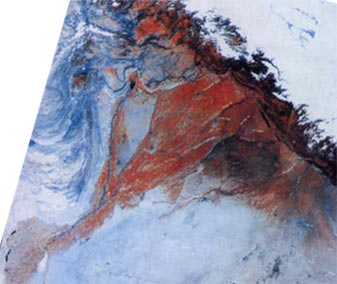
• Satellite imagery of the Indus-Sarasvata River system,
• Carbon and Thermoluminiscence Dating of archaeological artifacts
• Scientific Verification of Scriptural statements
• Linguistic analysis of scripts found on archaeological artifacts
• A Study of cultural continuity in all these categories.


Introduction
 Early indologists wished to control & convert the followers of Vedic Culture, therefore they widely propagated that the Vedas were simply mythology.
Max Muller, perhaps the most well known early sanskritist and indologist, although later in life he glorified the Vedas, initially wrote that the "Vedas were worse than savage" and "India must be conquered again by education... it's religion is doomed"
 Thomas Macaulay, who introduced English education into India wanted to make the residents into a race that was: "Indian in blood and color, but English in taste, in opinion, in morals, and in intellect."
However, the German Philosopher Arthur Schopenhauer stated that theSanskrit understanding of these Indologists was like that of young schoolboys.
 These early Indologists:
• Devised the Aryan Invasion theory, denying India's Vedic past
• They taught that the English educational system is superior
• They intentionally misinterpreted sanskrit texts to make the Vedas look primitive.
• And they systematically tried to make Indians ashamed of their own culture
• Thus the actions of these indologists seems to indicate that they were motivated by a racial bias.
Innumerable archaeological findings and their analysis have recently brought the Aryan Invasion Theory into serious question. This theory is still taught as fact in many educational systems despite much contrary evidence.

The Aryan Invasion Theory Defined
• Vedic Aryans entered India between 1,500 and 1,200 B.C.
• They conquered the native Dravidian culture by virtue of their superiority due to their horses & iron weapons
• They Imported the Vedic culture and it's literatures.
• This Aryan Invasion Theory, however, deprives the inhabitants of India of their Vedic heritage. The wealth of their culture came from foreign soil.
The Aryan Invasion Theory raises an interesting dilemna called Frawleys Paradox: On the one hand we have the vast Vedic Literature without any archaeological finds associated with them and on the other hand, we have 2,500 archaeological sites from the Indus-Sarasvata civilization without any literature associated with them.


A preponderance of contemporary evidence now seems to indicate that these are one and the same cultures. This certainly eliminates this paradox and makes perfect sense, to an unbiased researcher.
Facts which cast serious doubt on the Aryan Invasion Theory
• There is no evidence of an Aryan homeland outside of India mentioned anywhere in the Vedas. On the contrary, the Vedas speak of the mighty Sarasvati River and other places indigenous to India. To date, no evidence for a foreign intrusion has been found, neither archaeological, linguistic, cultural nor genetic.
• There are more than 2,500 Archaeological sites, two-thirds of which are along the recently discovered dried up Sarasvati River bed. These sites show a cultural continuity with the Vedic literature from the early Harrapan civilization up to the present day India.
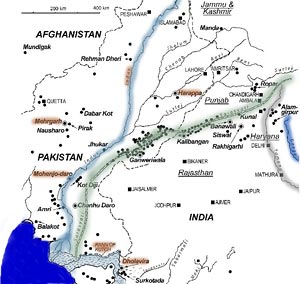
The archaeological sites along the dried up Sarasvati River basin are represented by black dots.
• Several independent studies of the drying up of the Sarasvati River bed, all indicate the same time period of 1,900 B.C.E.
• The significance of establishing this date for the drying up of the Sarasvati River is, that it pushes the date for the composition of the Rig Veda back to approximately 3,000 B.C.E., as enunciated by the Vedic tradition itself.
 • The late dating of the Vedic literatures by indologists is based on speculated dates of 1,500 B.C.E. for the Aryan Invasion and 1,200 B.C.E. for the Rig Veda, both now disproved by scientific evidence.Max Muller, the principal architect of the Aryan Invasion theory, admitted the purely speculative nature of his Vedic chronology, and in his last work published shortly before his death, The Six Systems of Indian Philosophy, he wrote: "Whatever may be the date of the Vedic hymns, whether 15 hundred or 15,000 B.C.E., they have their own unique place and stand by themselves in the literature of the world."
The Vedic Culture is indigenous to India
It can be scientifically proven that the Vedic Culture is indigenous, through archaeology, the study of cultural continuity, by linguistic analysis, and genetic research.


For example, the language and symbolism found on the Harappan seals are very Vedic. We find the Om symbol, the leaf of the Asvatta or holy banyan tree, as well as the swastika, or sign of auspiciousness, mentioned throughout the Vedas. Om is mentioned in the Mundaka and Katha Upanisads as well as the Bhagavad Gita.
 The Holy Asvatta tree is mentioned in the Aitareya and SatapataBrahmanas as well as the Taittiriya Samhita and KatyayanaSmrti.
The pictoral script of these Harappan seals has been deciphered as consistently Vedic and termed "Proto-brahmi," as a pre-sanskrit script.
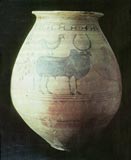
 This piece of pottery from the lowest level of Harappan excavations with pre-harappan writing is deciphered asila vartate vara, referring to the sacred land bounded by the Sarasvati River, described in the Rig Veda.
Additionally, other archaeological finds are culturally consistent, such as the dancing girl, whose bracelets are similar to those worn by women of Northwest India today as well as


the three stone Siva Lingas found in Harappa by M. S. Vats in 1940. The worship of the Siva Linga is mentioned in the Maha Narayana Upanisad of the Yajur Veda and is still ardently practiced today.


The Vedas were maligned by early indologists because of their disagreement with their Eurocentric colonialists world view, a view which produced and depended on the Aryan Invasion Theory. The fact that the Aryan Invasion Theory has been seriously challenged recently by scholars and indologists, adds credence to the Vedas as viable, accurate and indigenous sources of information.
Satellite imagery of the Dried Up Sarasvati River Basin
Using modern scientific methods, such as satellite imagery and dating techniques, it can be shown that the ancient statements of the Vedas are factual, not mythical as erroneously propagated. High resolution satellite images have verified descriptions in The Rig Veda of the descent of the ancient Sarasvati River from it's source in the Himalayas to the Arabian Sea.
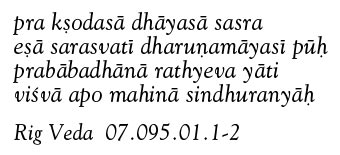
"Pure in her course from the mountains to the ocean, alone of streams Sarasvati hath listened."
The mighty Sarasvati River and it's civilization are referred to in the Rig Veda more than fifty times, proving that the drying up of the Sarasvati River was subsequent to the origin of the Rig Veda, pushing this date of origin back into antiquity, casting further doubt on the imaginary date for the so-called Aryan Invasion.
The Satellite image (above) clearly shows the Indus-Sarasvata river system extending from the Himalayas to the Arabian Sea. Here the Indus River is on the left, outlined in blue, while the Sarasvati River basin is outlined in green. The black dots are the many archeological sites or previous settlements along the banks of the now dry Sarasvati River.
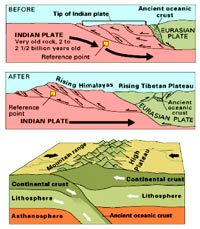
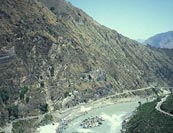 The drying up of the Sarasvati River around 1900 B.C.E. is confirmed archaeologically. Following major tectonic movements or plate shifts in the Earth's crust, the primary cause of this drying up was due to the capture of the Sarasvati River's main tributaries, the Sutlej River and the Drishadvati River by other rivers.
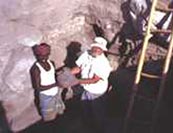 Although early studies, based on limited archaeological evidence produced contradictory conclusions, recent independent studies, such as that of archaeologist James Shaffer in 1993, showed no evidence of a foreign invasion in the Indus Sarasvata civilization and that a cultural continuity could be traced back for millennia.
In other words, Archaeology does not support the Aryan Invasion Theory.
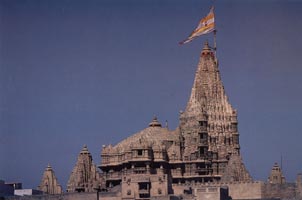 Evidence for the Ancient Port City of Dvaraka
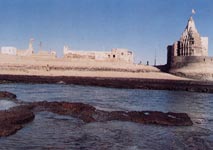
Marine archaeology has also been utilized in India off the coast of the ancient port city of Dvaraka in Gujarat, uncovering further evidence in support of statements in the Vedic scriptures. An entire submerged city at Dvaraka, the ancient port city of Lord Krishna with its massive fort walls, piers, warfs and jetty has been found in the ocean as described in the Mahabharata and other Vedic literatures.
This sanskrit verse from the Mausala Parva of theMahabharata, describes the disappearance of the city of Dvaraka into the sea.
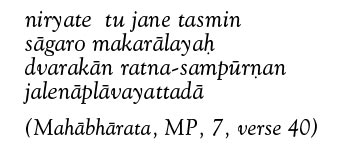
"After all the people had set out, the ocean flooded Dvaraka, which still teemed with wealth of every kind. Whatever portion of land was passed over, the ocean immediately flooded over with its waters."
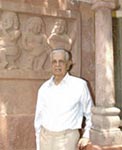 Dr. S. R. Rao, formerly of the Archaeological Survey of India, has pioneered marine archaeology in India. Marine archaeological findings seem to corroborate descriptions in the Mahabharata of Dvaraka as a large, well-fortified and prosperous port city, which was built on land reclaimed from the sea, and later taken back by the sea. This lowering and raising of the sea level during these same time periods of the 15th and 16th centuries B.C.E. is also documented in historical records of the country of Bahrain.
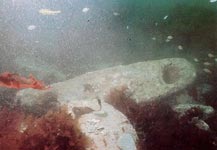
Amongst the extensive underwater discoveries were the massive Dvaraka city wall, a large door-socket and a bastion from the fort wall.
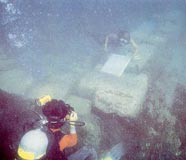
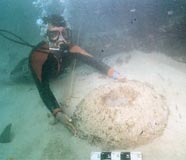
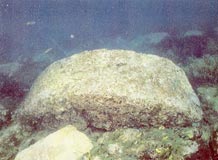
Two rock-cut slipways of varying width, extending from the beach to the intertidal zone, a natural harbor, as well as a number of olden stone ship anchors were discovered, attesting to Dvaraka being an ancient port city.
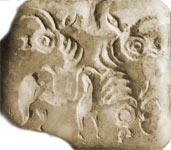
The three headed motif on this conch-shell seal (above), found in the Dvaraka excavations, corroborates the reference in the scripture Harivamsa that every citizen of Dvaraka should carry a mudra or seal of this type.
All these underwater excavations add further credibility to the validity of the historical statements found in the Vedic literatures.
Thirty-five Archaeological Sites in North India
Apart from Dvaraka, more than thirty-five sites in North India have yielded archaeological evidence and have been identified as ancient cities described in the Mahabharata. Copper utensils, iron, seals, gold & silver ornaments, terracotta discs and painted grey ware pottery have all been found in these sites. Scientific dating of these artifacts corresponds to the non-aryan-invasion model of Indian antiquity.
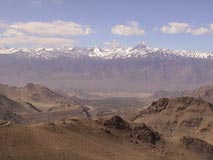
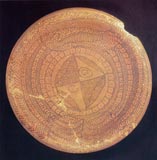
Furthermore, the Matsya and Vayu Puranas describe great flooding which destroyed the capital city of Hastinapur, forcing its inhabitants to relocate in Kausambi. The soil of Hastinapur reveals proof of this flooding. Archaeological evidence of the new capital of Kausambi has recently been found which has been dated to the time period just after this flood.
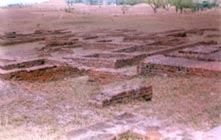
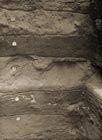
Kurukshetra
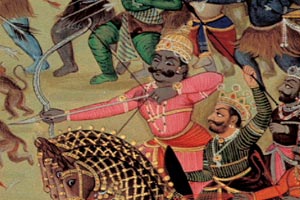
Similarly, in Kurukshetra, the scene of the greatMahabharata war, Iron arrows and spearheads (according to some sources) have been excavated and dated by thermoluminence to 2,800 B.C.E., the approximate date of the war given within the Mahabharata itself.
The Mahabharata also describes three cities given to the Pandavas, the heroes of the Mahabharata, after their exile:
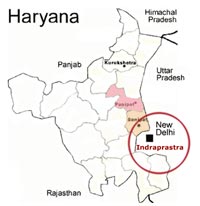 Paniprastha, Sonaprastha & Indraprastha, which is Delhi's Puranaqila. These sites have been identified and yielded pottery & antiquities, which show a cultural consistency & dating consistent for theMahabharata period, again verifying statements recorded in the Vedic literatures.
Renowned Thinkers Who Appreciated the Vedic Literatures
Although early indologists, in their missionary zeal, widely vilified the Vedas as primitive mythology, many of the worlds greatest thinkers admired the Vedas as great repositories of advanced knowledge and high thinking
Arthur Schopenhauer, the famed German philosopher and writer, wrote that: I "...encounter [in the Vedas] deep, original, lofty thoughts... suffused with a high and holy seriousness."
 The well-known early American writer Ralph Waldo Emerson, read the Vedas daily. Emerson wrote: "I owed a magnificent day to the Bhagavat-Gita"
 Henry David Thoreau said: "In the morning I bathe my intellect in the stupendous philosophy of the Bhagavad Gita... in comparison with which... our modern world and its literature seems puny and trivial."
So great were Emerson and Thoreau's appreciation of Vedantic literatures that they became known as the American transcendentalists. Their writings contain many thoughts from Vedic Philosophy.
 Other famous personalities who spoke of the greatness of the Vedas were: Alfred North Whitehead (British mathematician, logician and philosopher), who stated that: "Vedanta is the most impressive metaphysics the human mind has conceived."
 Julius Robert Oppenheimer, the principle developer of the atomic bomb, stated that "The Vedas are the greatest privilege of this century." During the explosion of the first atomic bomb, Oppenheimer quoted several Bhagavad-gita verses from the 11th chapter, such as:
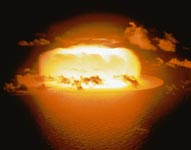 "Death I am, cause of destruction of the worlds..."
When Oppenheimer was asked if this is the first nuclear explosion, he significantly replied: "Yes, in modern times," implying that ancient nuclear explosions may have previously occurred.

Lin Yutang, Chinese scholar and author, wrote that: "India was China's teacher in trigonometry, quadratic equations, grammar, phonetics... " and so forth.
Francois Voltaire stated: "... everything has come down to us from the banks of the Ganges."
From these statements we see that many renowned intellectuals believed that the Vedas provided the origin of scientific thought.
The Iron Pillar of Delhi
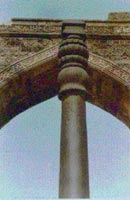 The Vedic literatures contain descriptions of advanced scientific techniques, sometimes even more sophisticated than those used in our modern technological world.
Modern metallurgists have not been able to produce iron of comparable quality to the 22 foot high Iron Pillar of Delhi, which is the largest hand forged block of iron from antiquity.
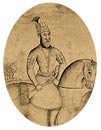 This pillar stands at mute testimony to the highly advanced scientific knowledge of metallurgy that was known in ancient India. Cast in approximately the 3rd century B.C., the six and a half ton pillar, over two millennia has resisted all rust and even a direct hit by the artillary of the invading army of Nadir Shah during his sacking of Delhi in 1737.
Vedic Cosmology


Vedic Cosmology is yet another ancient Vedic science which can be confirmed by modern scientific findings and this is acknowledged by well known scientists and authors, such as Carl Sagan and Count Maurice Maeterlinck, who recognized that the cosmology of the Vedas closely parallels modern scientific findings.
Carl Sagan stated, "Vedic Cosmology is the only one in which the time scales correspond to those of modern scientific cosmology."
Nobel laureate Count Maurice Maeterlinck wrote of: "a Cosmogony which no European conception has ever surpassed."
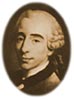 French astronomer Jean-Claude Bailly corroborated the antiquity and accuracy of the Vedic astronomical measurements as "more ancient than those of the Greeks or Egyptians." And that, "the movements of the stars calculated 4,500 years ago, does not differ by a minute from the tables of today."
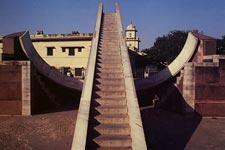 The ninety foot tall astronomical instrument known as Samrat Yantra, built by the learned King Suwai Jai Singh of Jaipur, measures time to within two seconds per day.
 Cosmology and other scientific accomplishments of ancient India spread to other countries along with mercantile and cultural exchanges. There are almost one hundred references in the Rig Veda alone to the ocean and maritime activity. This is confirmed by Indian historian R. C. Majumdar, who stated that the people of the Indus-Sarasvata Civilization engaged in trade with Sooma and centers of culture in western Asia and Crete.
The Heliodorus Column and Cultural Links to India
An example of these exchanges is found in the inscriptions on the Heliodorus Column, erected in 113 B.C.E. by Heliodorus, a Greek ambassador to India, and convert to Vaisnavism, as well as the 2nd century B.C.E. Coins of Agathocles, showing images of Krishna and Balaram. These artifacts stand testimony that Sanatan Dharma predates Christianity.

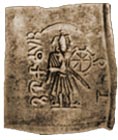
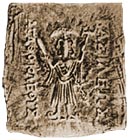
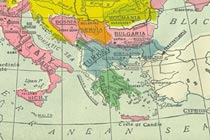
This also confirms the link between India and other ancient civilizations such as Greece and shows that there was a continuous exchange of culture, philosophy and scientific knowledge between India & other countries. Indeed the Greeks learned many wonderful things from India.
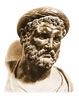 Voltaire, the famous French writer and philosopher) stated that "Pythagoras went to the Ganges to learn geometry." Abraham Seidenberg, author of the authoritative "History of Mathematics," credits the Sulba Sutras as inspiring all mathematics of the ancient world from Babylonia to Egypt to Greece.
As Voltaire & Seidenberg have stated, many highly significant mathematical concepts have come from the Vedic culture, such as:
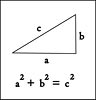
The theorem bearing the name of the Greek mathematician Pythagorus is found in theShatapatha Brahmana as well as the Sulba Sutra, the Indian mathematical treatise, written centuries before Pythagorus was born.
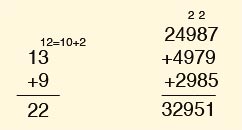
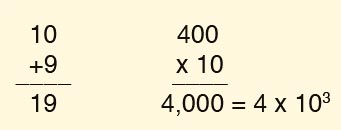
The Decimal system, based on powers of ten, where the remainder is carried over to the next column, first mentioned in the Taittiriya Samhita of the Black Yajurveda.
The Introduction of zero as both a numerical value and a place marker.
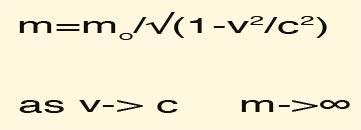
T he Concept of infinity.
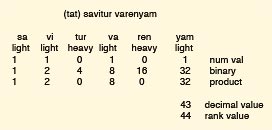
The Binary number system, essential for computers, was used in Vedic verse meters.
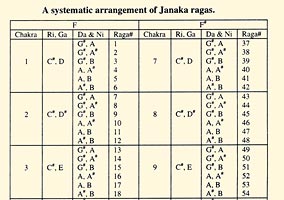
A hashing technique, similar to that used by modern search algorithms, such as Googles, was used in South Indian musicology. From the name of a raga one can determine the notes of the raga from this Kathapayadi system. (See Figure at left.)
For further reading we refer you to this excellent article onVedic Mathematics.
Vedic Sound and Mantras
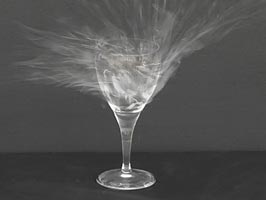 The Vedas however are not as well known for presenting historical and scientific knowledge as they are for expounding subtle sciences, such as the power of mantras. We all recognize the power of sound itself by it's effects, which can be quite dramatic. Perhaps we all have seen a high-pitched frequency shatter an ordinary drinking glass. Such a demonstration shows that Loud Sounds can produce substantial reactions
It is commonly believed that mantras can carry hidden power which can in turn produce certain effects. The ancient Vedic literatures are full of descriptions of weapons being called by mantra. For example, many weapons were invoked by mantra during the epic Kuruksetra War, wherein the Bhagavad-gita itself was spoken.
The ancient deployment of Brahmastra weapons, equivalent to modern day nuclear weapons are described throughout the Vedic literatures. Additionally, mantras carry hidden spiritual power, which can produce significant benefits when chanted properly. Indeed, the Vedas themselves are sound vibrations in literary form and carry a profound message. Spiritual disciplines recommend meditational practices such as silent meditation, silent recitation of mantras and also the verbal repetition of specific mantras out loud. A Clinical Test of the Benefits of Mantra Chanting was performed on three groups of sixty-two subjects, males and females of average age 25. They chanted the Hare Krsna Maha Mantra twenty-five minutes each day under strict clinical supervision.
Results showed that regular chanting of the Hare Krsna Maha Mantra reduces Stress and depression and helps reduce bad habits & addictions. These results formed a PhD Thesis at Florida State University.
Spiritual practitioners claim many benefits from Mantra Meditation such as increased realization of spiritual wisdom, inner peace and a strong communion with God and the spiritual realm. These effects may be experienced by following the designated spiritual path.
Conclusion
Most of the evidence given in this presentation is for the apara vidya or material knowledge of the Vedic literatures. The Vedas however, are more renowned for their para vidya or spiritual knowledge. And even superior is the realized knowledge of the Vedic rsis or saints — that which is beyond the objective knowledge of modern science — knowledge of the eternal realm of sat, cit ananda, eternality, blissfullness and full knowledge. But that is another presentation.
The Scientific Verification of Vedic Knowledge is available as a more extensive video from DevaVision Video Documentaries or Amazon.com as well as a PDF chapter in Science of the Sacred. It is also available on uTube.
